What Makes Yellowstone Unique
Established in 1872, Yellowstone was the world’s first national park - and it remains one of the most extraordinary places on Earth. Spanning 2.2 million acres across Wyoming, Montana, and Idaho, it sits atop one of the world’s largest supervolcano systems, which powers its legendary geysers, hot springs, and geothermal features. For families, it’s an open-air science lesson on a scale that defies imagination.
Key Highlights for Families
Geysers and Hot Springs
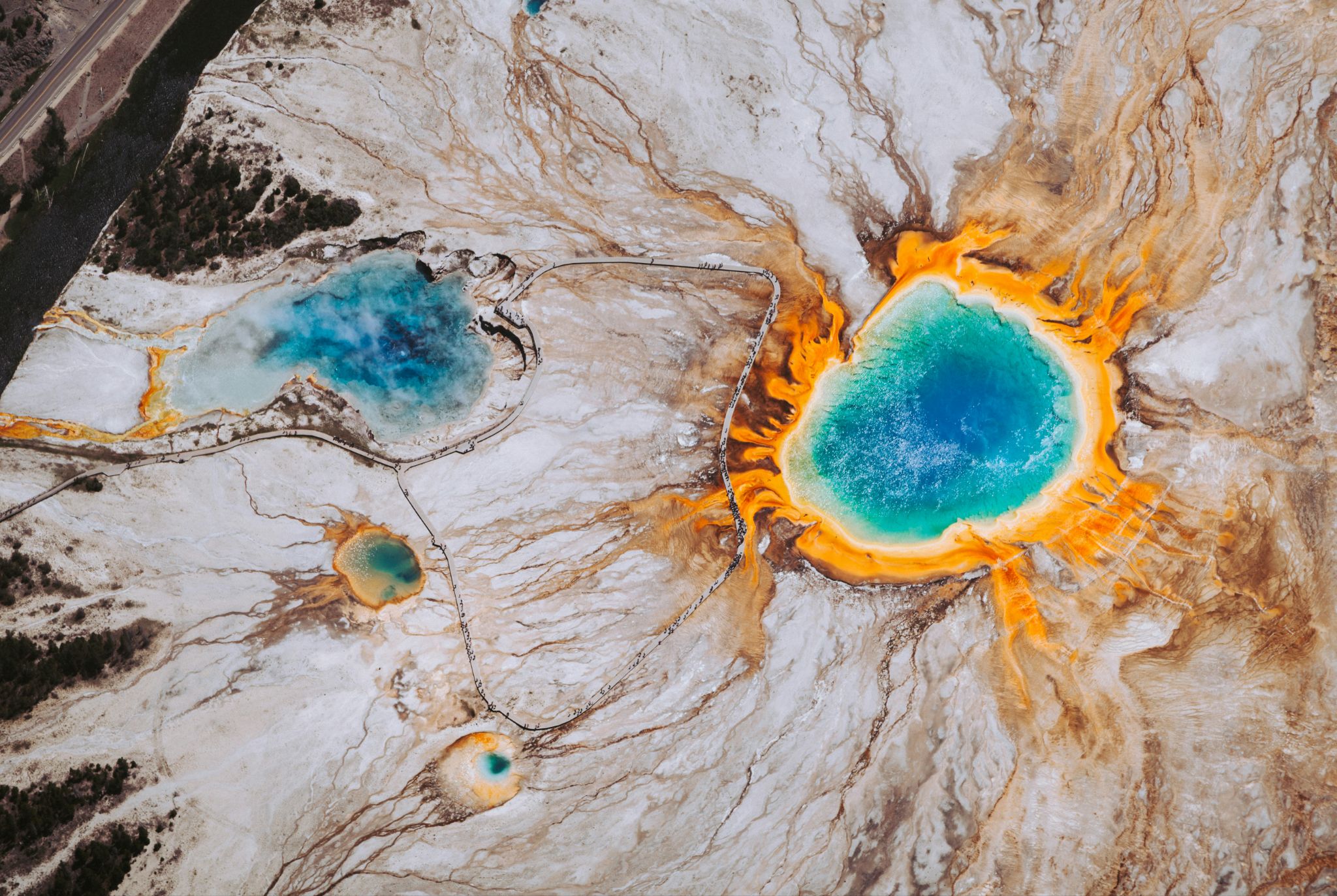
Yellowstone’s geothermal features are in a category of their own. Old Faithful is the most famous geyser in the world, erupting on a roughly 90-minute schedule and sending boiling water up to 185 feet into the air - every time, reliably, to an audience of delighted visitors. But Old Faithful is just the beginning. The Grand Prismatic Spring is a vivid, steaming rainbow of a hot spring - the largest in the United States - whose colors shift from deep blue at the center to brilliant orange and yellow at the edges, created by heat-tolerant microorganisms. Further north, the Mammoth Hot Springs terraced formations look like something from a science fiction landscape, with mineral-depositing water cascading over white and cream-colored terraces in constantly shifting patterns.
Wildlife Encounters
Yellowstone’s wildlife is genuinely spectacular. Hayden Valley is the best place in the park to see bison herds - sometimes numbering in the hundreds - grazing across a wide, open valley. Lamar Valley in the park’s northeast corner is the premier spot for wolf and bear sightings; early mornings are best. Throughout the park, bald eagles and ospreys circle above the Yellowstone River, and pronghorn antelope are a common sight along roadsides. Important note: always maintain safe distances from all wildlife. Bison are more dangerous than they appear and charge without warning.
Scenic Hikes and Views
For dramatic canyon scenery, nothing in Yellowstone compares to the view from Artist Point, overlooking the Grand Canyon of the Yellowstone and the Lower Falls plunging 308 feet into the canyon below. The colors - yellows, oranges, and reds in the canyon walls, deep blue water below - are extraordinary. The Mystic Falls Trail near Old Faithful is a gentle family hike to a lovely backcountry waterfall. And the upper rim trails along the Grand Canyon of the Yellowstone offer a series of overlooks that reward every step.
Practical Tips for Your Yellowstone Visit
- Best time to visit is May through September; July and August are peak - book lodging 12+ months in advance
- Book lodges inside the park or nearby gateway towns (West Yellowstone, Gardiner, Cody)
- Pack layers - temperatures can swing 40 degrees between morning and afternoon
- Bring sturdy shoes, reusable water bottles, and binoculars for wildlife viewing
- Always stay on boardwalks near geothermal features - the crust can be dangerously thin
- Maintain 100 yards from bears and wolves, 25 yards from all other wildlife
- Carry bear spray and know how to use it
- Enroll kids in the Junior Ranger Program - available at every visitor center, a fantastic engagement tool
As we drove away from Yellowstone at the end of our trip, our youngest looked back and said, “I feel like we just walked through a storybook!” That’s the beauty of Yellowstone - it produces moments of wonder that children carry with them for years. It’s not just a park. It’s a place that changes how you see the natural world.
“In every walk with nature, one receives far more than he seeks.” - John Muir